
Overview: Recent research highlights a massive shift in renter behavior, showing that leads referred through multifamily AI search convert 3-6x higher than traditional search traffic. This creates a winner-take-all scenario where only 15% of brands are currently capturing the vast majority of these high-intent leads. Properties must move beyond basic keywords and focus on data integrity and structured visibility. This deep dive explores how multifamily AI search is redefining digital authority and what portfolios need to do to join the elite group of properties dominating the future of search.
Surviving the Winner-Take-All Crisis in Multifamily Search
A quiet but violent shift is occurring in how renters find their next home.
It isn’t happening on the billboards of the I-95 or even the traditional grid of a Google search results page. It is happening inside the conversational interfaces of ChatGPT, Perplexity, and Claude.
Recent research has uncovered a startling disparity in the digital economy: users who are referred to a brand via AI search engines are 3 to 6 times more likely to convert than those coming from traditional search.
These are the highest-intent leads the multifamily industry has ever seen. They have moved past the discovery phase and into the decision phase, guided by an algorithmic recommendation they trust.
However, there is a catch that should keep every regional manager and marketing director awake at night. Only 15% of brands are currently capturing more than 80% of these high-converting recommendations.
But we all know there is no second page of Google in multifamily AI search. There is only the recommendation — and everyone else.
This is what we call the winner-take-all crisis, where a small group of properties will dominate the market simply because they know how to talk to the machines.
The High-Stakes Math of AI Referrals
To understand the urgency of multifamily AI SEO, we have to look at the psychology of the modern renter.
Traditional search is an active, often exhausting chore. A renter types “luxury apartments in Downtown Austin,” scrolls past four ads, ignores the map pack, and begins clicking through 10 different websites to cross-reference pet policies, parking fees, and floor plans.
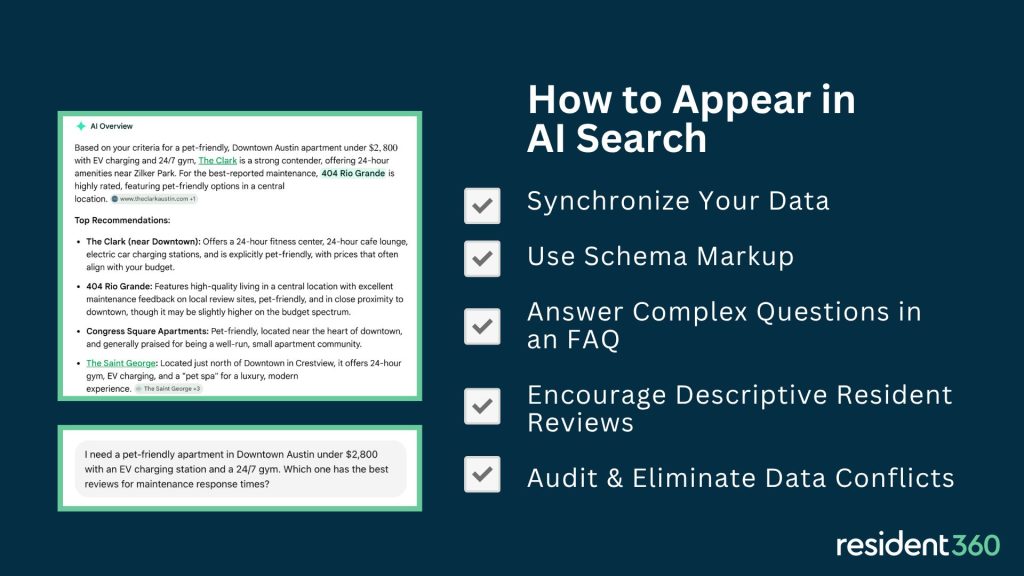
AI search completely changes how renters do their homework. Instead of spending hours digging through tabs, a renter simply asks: “I need a pet-friendly apartment in Downtown Austin under $2,800 with an EV charging station and a 24/7 gym. Which one has the best reviews for maintenance response times?”
The AI does the cross-referencing in milliseconds. When it returns a result, it isn’t providing a list of links; it is providing an answer.
This explains why research shows these leads convert at such a massive multiple. The friction of the search has been removed. By the time the renter clicks through to your tour page, the AI has already sold them on the fact that your property meets every one of their specific criteria.
If your property is the one being recommended, your cost per lease plummets. If you are part of the 85% left out of the conversation, your property becomes digitally invisible to the most qualified leads in the market.
The 15% Club: Why Multifamily Is Falling Behind
Most multifamily brands are still optimizing for 2018. They focus on keyword density, backlink quantity, and meta descriptions. While those still matter for traditional Google traffic, they are insufficient for AI search for apartments.
AI search engines don’t care about keyword density; they care about certainty. They cross-reference your website with third-party sites and reviews to make sure your information is accurate. The brands winning 80% of the recommendations are the ones that provide a single, unified source of truth that the AI can actually trust.
Multifamily data is notoriously messy. A property might be listed with one pet policy on an ILS, a different one on the official website, and have a string of Google reviews complaining about a policy that changed six months ago.
To an AI, this inconsistency signals a lack of authority. If the AI isn’t 100% sure about your data, it won’t risk its reputation by recommending you to the user. It will instead recommend the competitor whose data is structured, verified, and consistent.
If you want to dive deeper into AI SEO, listen to our full conversation on What’s Working Right Now in Multifamily AI SEO for actionable tips on winning the zero-click search battle.
Moving Toward Multifamily AI Search Engine Optimization
Winning in this new environment requires a shift from SEO as a multifamily marketing tactic to SEO as a data integrity strategy. AI SEO for apartments is about building a footprint that an LLM can ingest without confusion.
The Death of the Keywords-Only Strategy
Traditional SEO was about being found. Multifamily AI search is about being understood.
AI models look for entities, not just strings of text. Your property is an entity with attributes: price, location, amenities, sentiment, and reputation.
To join the 15% Club, properties must use schema markup (the hidden code that tells a search engine exactly what a number or a word means). If your apartment website doesn’t explicitly tell an AI in its own language that $2,500 is the starting price for a one-bedroom unit, the AI has to guess.
In a winner-take-all crisis, the AI doesn’t guess; it moves on to the property that provided the structured data.
Sentiment as a Ranking Factor
AI search models are trained on human conversations. They read reviews, Reddit threads, and social media comments to gauge the vibe of a property. If a renter asks for a quiet apartment, the AI isn’t looking for the word quiet in your headers. It’s looking for residents who mentioned thick walls or no street noise in their reviews.
This means that reputation management is no longer just a customer service function; it is a core pillar of multifamily AI search engine optimization. Your digital reputation is the social proof the AI uses to justify its recommendation.
The Gap Is Widening
The danger of the 15% Club is the feedback loop. When AI recommends a property, it gets the click. That click leads to a tour. That tour leads to a lease. That resident (hopefully) leaves a positive review. The AI sees the new review and the increased traffic, which reinforces its belief that this property is the best recommendation.
Meanwhile, the properties in the 85% see their organic traffic stagnate. They respond by increasing their spend on paid ads (PPC) and ILS premiums. But as AI search becomes the primary interface for the discovery phase, even the most expensive Google Ads will see diminishing returns.
You cannot buy your way into a ChatGPT conversation the same way you can buy your way to the top of a search results page. You have to earn the recommendation through data authority.
The Technical Reality of AI SEO for Apartments
To compete, property owners and managers must treat their website as a data source, not just a brochure. This involves:
- Direct Data Feeds: Ensuring that your real-time availability and pricing are accessible to web crawlers in a structured format.
- Narrative Authority: Creating content that answers the specific, long-tail questions renters are asking. Instead of “Downtown Apartments,” think “Apartments with the best floor-to-ceiling views of the Austin skyline.”
- Cross-Platform Consistency: If your Yelp profile says you have a pool, but your website doesn’t mention it, the AI sees a data conflict. To avoid giving a renter the wrong information, the AI will simply stop recommending your property altogether.
The Future of the Funnel
The goal of multifamily AI SEO is to be the suggested answer. We are moving away from a world where we want to be one of 10 options. We want to be the only option presented to a high-intent user.
The 3-6x conversion multiplier isn’t a fluke; it’s a reflection of the trust users place in these tools.
When an AI tells a renter, “Based on your preferences, The Elmwood is your best match because it’s the only one in your price range with a dedicated co-working space,” the sale is halfway done.
The multifamily industry is at a crossroads. The transition to AI search isn’t a future trend to be addressed in the next fiscal year. It is a live crisis of visibility.
The 15% Club is already being formed. The properties that audit their data, embrace a structured schema, and optimize for the algorithm will capture the lion’s share of leads.
The rest will be left fighting for the scraps of a traditional search landscape that is rapidly disappearing.
In short, being good isn’t enough. You have to be the answer.