150+ Apartment Concessions (& Why They Are or Aren’t Working)
Overview: Apartment concessions are at an all-time high, with 37.3% of U.S. rental listings currently offering some form of incentive, according to Zillow. In high-supply markets like Denver (68%), Austin (63.8%), and Charlotte (66.6%), free rent has become the baseline expectation rather than a competitive differentiator. This article covers why perceived value matters more than dollar amount, when concessions are and aren’t the right tool, and includes a list of 150+ apartment concessions currently being offered by apartment communities across the country.
The Rent Concession Everyone’s Offering Is the One Nobody Notices
Walk through any high-supply apartment market right now, and you’ll see the same sign everywhere: One month free. Maybe two. Sometimes two and a half.
It’s on every ILS listing, every banner ad, every property website. And that’s exactly the problem.
When every property in your submarket is running the same rent concession, that offer stops being a differentiator. It becomes the floor. The baseline. Renters expect it before they even start looking — and at that point, you’re not attracting anyone new; you’re just giving away revenue to people who would have leased anyway.
Apartment concessions are at a record high right now. According to Zillow’s latest data, 37.3% of active apartment listings nationwide include some type of concession — a new all-time high.
RealPage data shows stabilized properties are offering an average of five weeks of free rent, the most since the Great Financial Crisis. In markets like Denver (68% of listings), Charlotte (66.6%), Dallas (64.2%), and Austin (63.8%), a concession isn’t an offer anymore — it’s a given.
So the question isn’t whether you should offer a rent concession. In a lot of markets, you probably have to. The question is: what kind? And more importantly — what are you doing to stand out when your competitors are all running the exact same playbook?
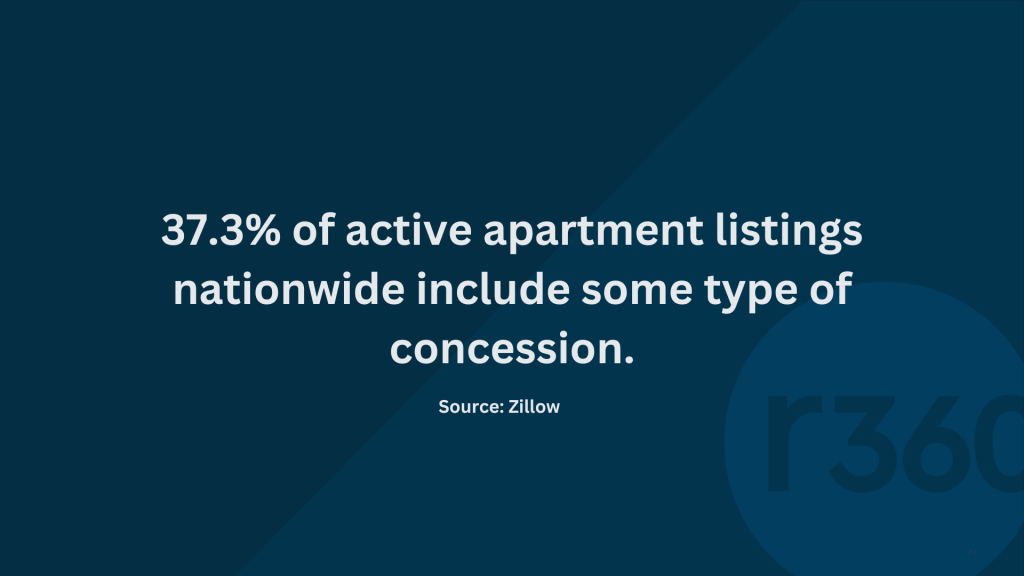
The One-Month-Free Trap
Here’s something worth thinking about. In markets where new supply has been flooding in (Austin, Nashville, Denver, Phoenix, the Florida Gulf Coast) properties are stacking apartment concessions just to tread water.
Sarasota, Florida is averaging nearly eight weeks of free rent on new leases right now. Fort Myers, Lakeland, and Naples are all around seven weeks. These aren’t lease-up properties; they’re stabilized communities fighting to maintain occupancy.
And yet, despite all that rent being given away, leasing velocity isn’t dramatically improving for most of them. Why? Because everyone’s doing it. When 64% of Austin properties are offering two months free, your two months free doesn’t make anyone pick up the phone. It just means you’re offering what’s expected.
The issue with defaulting to free rent as your multifamily marketing strategy is that it competes on a dimension where you can’t win. There’s always someone willing to go one more week. One more month. And if your competitor has deeper pockets or a more motivated ownership group, they’ll outlast you — while both of you are hemorrhaging NOI.
Perceived Value Is Everything
This is where it gets interesting, and it’s really the heart of what makes some concession strategies work, and most of them fall flat: perceived value.
Here’s a concrete example. A property right outside of Disney World in Central Florida is offering a VIP private fireworks viewing experience at Magic Kingdom as part of their concession package — on top of one month free. Think about that for a second.
As a property management company, two park tickets might run you $200-$300 per person, so call it $400-$600 total. But to a prospective renter? That’s a bucket-list experience. That’s something they’d never book on their own. It feels huge in a way that “6 weeks free” never will.
The rent on that property’s two-bedrooms is around $2,000/month. They’re giving away roughly the same dollar value as any other competitor in the market — but the feeling of what they’re offering is completely different. One is a line item on a spreadsheet. The other is a story you tell your friends.
This is the core of what a smart apartment concession strategy looks like: same cost (or less), dramatically higher perceived value.
Another example: a property offering furniture packages. A leasing agent walks a prospect through a beautifully staged two-bedroom and the prospect falls in love with the couch. The agent says, “That’s actually part of your move-in package — would you like that as your concession?” That couch might cost $1,200. On a $3,000/month lease, you’ve just offered a concession worth a fraction of one month’s rent — and the renter feels like they got something personal, something real, something they can use. Compare that to just knocking a month off rent, which they’ll mentally absorb into their budget and forget by move-in day.
Or this one: a coastal property offering six weeks of surf lessons as their concession. Six weeks of surf lessons sounds extravagant. It sounds like a lifestyle. To most people, it’s something they’d never invest in on their own — it seems like a lot of money and a big commitment. But the actual cost is roughly equivalent to one month’s rent. Same spend. Wildly different impression.
We dug into all of this on a recent episode of the Multifamily Marketers podcast — including some of the most creative (and most overrated) apartment concessions out there right now. If you want to hear the full conversation, it’s worth a listen:
150+ Apartment Concessions Being Offered Right Now
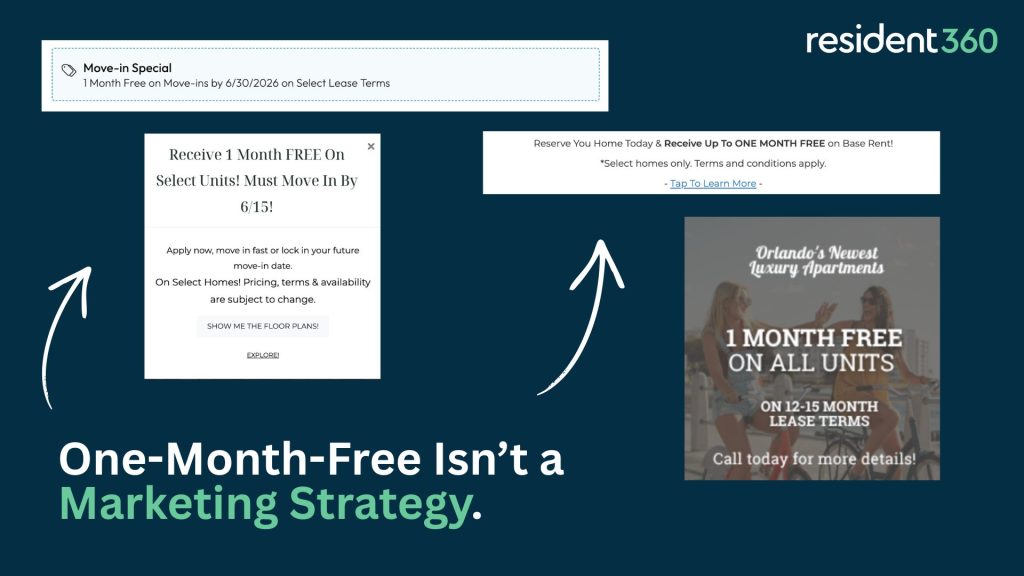
To show just how wide the range actually is, we gathered rent concessions from properties across the nation. Here’s a look at what properties across the country are currently putting on the table.
Rent & Financial
- 1 month free rent
- 2 months free rent
- 3 months free rent
- 6 weeks free rent
- 8 weeks free rent
- 10 weeks free rent
- 12 weeks free rent
- Half-month free
- First week free
- Prorated free rent spread across 12-month lease
- $500 off first month
- $1,000 move-in credit
- $1,500 move-in credit
- $2,000 move-in credit
- $2,500 cash at signing
- Reduced rent for first 3 months
- Rate-lock guarantee for 2-year lease renewal
- No rent increase at renewal
- Rent matched to any competitor’s advertised price
Fees Waived
- Waived application fee
- Waived admin fee
- Waived move-in fee
- Waived security deposit
- Half-off security deposit
- Waived pet deposit
- Waived pet rent for first year
- Waived amenity fee for first year
- Waived parking fee for first year
- Waived storage fee for first year
- Waived late fee for first 6 months
- Broker fee paid by landlord
Parking & Transportation
- Free covered parking for lease term
- Free garage parking for first year
- Free EV charging station access
- Free bike storage
- Free valet parking for 3 months
- Free valet parking for full lease term
- Reserved parking spot upgrade at no charge
- Moving truck rental reimbursement
- $500 toward moving costs
- $1,000 toward moving costs
- Discounted move via partner moving company
Tech & Smart Home
- Smart lock installed at move-in
- Smart thermostat (Nest or equivalent)
- Ring video doorbell
- Smart home hub/tablet
- Amazon Echo or smart speaker
- Free 55″+ smart TV
- $500 Apple gift card
- $1,000 Apple gift card
- Amazon gift card ($200–$500)
- Streaming bundle subscription for 1 year (Netflix, Hulu, Disney+)
- Amazon Prime membership for 1 year
Internet & Utilities
- Free Wi-Fi for first year
- Internet included in lease
- First 3 months of internet covered
- Water and sewer included for first year
- Electric included for first 3 months
- All utilities included for first month
- Gas covered for first year
Unit Upgrades
- Stainless steel appliance upgrade
- In-unit washer/dryer included
- Custom paint color of resident’s choice
- Flooring upgrade
- Furniture package (choose pieces from the staged unit)
- Sofa or couch from the model unit
- New window treatments/blinds
- Countertop upgrade
- Smart appliance package
- Additional storage shelving installed
Services & Lifestyle
- Professional move-in cleaning
- Free monthly housecleaning for 6 months
- Free quarterly housecleaning for lease term
- Trash valet included
- Free dry cleaning pickup/delivery for 3 months
- Free dog walking for first month
- Free pet grooming session at move-in
- Concierge service for first 3 months
- Free package locker access
Food & Dining
- Local restaurant gift card ($100-$250)
- GrubHub or DoorDash credit
- Starbucks gift card
- Welcome wine or champagne package at move-in
- Catered move-in day meal
- Meal delivery service subscription (3 months)
- Grocery delivery subscription (3 months of Instacart or equivalent)
Fitness & Wellness
- External gym membership for 1 year
- Boutique fitness studio membership for 3 months
- Peloton membership for 1 year
- 3 complimentary personal training sessions
- Spa day gift card
- Massage package (3 sessions)
- Meditation app subscription (Calm or Headspace)
- Group fitness class package (yoga, pilates, barre)
Experiences & Entertainment
- Disney World park tickets (2)
- VIP private fireworks viewing at Magic Kingdom
- 6 weeks of surf lessons
- Concert tickets (local venue)
- Local sports team game tickets
- Movie theater passes
- Escape room experience for two
- Cooking class voucher
- Wine tasting experience
- Brewery or distillery tour
- Helicopter tour (coastal and scenic markets)
- Whale watching excursion
- Hot air balloon ride
- Go-kart experience
- Axe throwing passes
- Paddleboard or kayak rental (full day)
- Bike rental for first month
- Golf round at a local course
- Golf simulator access for 3 months
Travel & Cash Prizes
- Weekend hotel staycation (local property)
- $500 Airbnb credit
- $1,000 travel voucher
- Ski season pass (Epic or Ikon — mountain markets)
- $800 Visa gift card
- $500 Visa gift card
- $1,200 Visa gift card
- $50,000 cash sweepstakes prize
- 1 year of free rent sweepstakes
Local & Community-Focused
- Neighborhood welcome package (curated local business gift cards)
- Preferred employer discount for area hospitals, universities, or major employers
- First responder or military discount package
- Teacher move-in special
- Student move-in package
- Local coffee shop gift card
- Local gym or boutique fitness partnership discount
- Free tickets to local festivals or community events
Pet-Friendly
- Pet welcome kit (bed, toys, treats)
- First month of doggy daycare
- Free pet DNA test
- Monthly pet treat subscription
- Private patio or yard access upgrade
Lease Flexibility
- Look-and-lease special — sign within 24 hours, waive app and admin fees
- Look-and-lease + gift card combo
- Month-to-month at no premium for first 3 months
- Early lease termination fee waived (one-time)
- Flexible move-in date within 30-day window
- No rent increase guarantee at first renewal
- “Make the switch” — cover a portion of remaining lease at prior community for prospects mid-lease
Referrals & Social
- $500 referral bonus per signed lease
- Social media move-in contest — post your new home for a chance to win a month free
- Monthly resident raffle for gift cards or experiences
What Properties Are Actually Doing Differently
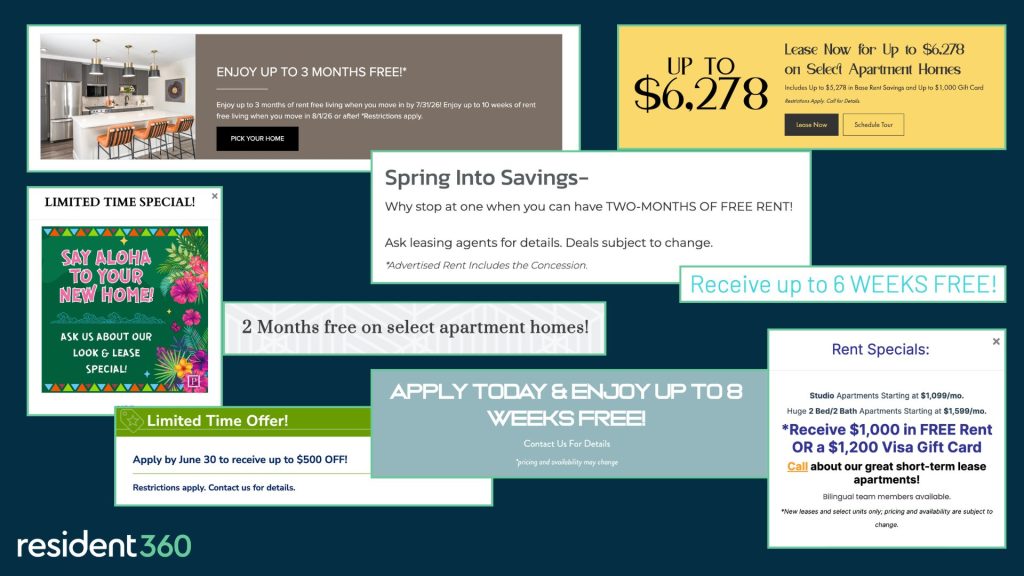
Beyond the concept, here’s what some of the more creative operators are doing (or have done in the past):
Revesco Properties — Akin Golden Triangle, Denver, CO
In one of the most saturated rental markets in the country, developer Revesco launched a sweepstakes tied to their property: one current or prospective resident won a full year of free rent ($2,175/month value), and another won $50,000 cash.
On top of that, the property was already offering up to 12 weeks free on longer leases, plus a choice of either a ski pass or an $800 Visa gift card. The sweepstakes was newsworthy enough to get picked up by the Colorado Sun. It drove genuine buzz in a neighborhood where nine competing properties were all delivering units at the same time.
Beaudry Tower — Los Angeles, CA (Brookfield Properties)
This 785-unit downtown tower was offering prospects 2 months’ free rent, a $500 Apple gift card, and 3 months of complimentary valet service. They also ran a parallel promotion offering $1,000-$2,500 cash at signing depending on unit size. The valet and Apple gift card combo is smart — valet is a recurring, visible benefit that makes residents feel taken care of every single day. It’s not a number on a lease; it’s an experience that reinforces the value of living there.
Moving Cost Partnerships
Some properties, particularly in markets with high lateral movement (renters moving from one community to another within the same submarket), are partnering with local moving companies and offering to cover $500-$1,000 of a prospect’s move.
The cost is manageable, but removing the friction of a move, especially when someone’s already stretched paying double rent during a transition, is genuinely meaningful. The perceived value is high because moving is stressful, and someone taking that stress off the table for you registers emotionally in a way that a rent discount doesn’t.
The “Make the Switch” Model
This one’s worth thinking through. The major cellphone carriers have spent billions of dollars training consumers to expect switching incentives, and it works. There’s a real multifamily marketing play here. If a prospect is three months into their current lease, you could offer to cover a portion of their remaining lease obligation if they commit to a longer term with you. It’s not a new concept, but it’s underused in multifamily, and in a market where your competitor is just saying “one month free,” it’s a completely different conversation.
When Concessions Are (and Aren’t) the Answer
Before we go further, it’s worth being honest about something: apartment concessions can’t fix operational problems. This is one of the most common mistakes we see — a property with low traffic or declining conversion rates reaches for a rent discount as the solution, when the real issue is something else entirely.
A better apartment concession means very little if your leasing team isn’t following up with leads; it just creates more volume for them to miss. When tours aren’t converting, the problem is almost always the tour experience itself rather than the promotion. Ultimately, no incentive is large enough to overcome a damaged online reputation driven by maintenance or operational issues that prospects can easily read about in your reviews and AI summaries.
Concessions make sense when:
- You’re in a lease-up and need to establish leasing velocity quickly
- You’re entering or competing in a high-supply submarket where renters genuinely have more options
- You’re repositioning or renovating and want to signal value during a transition
- You need to strategically manage seasonal occupancy dips
They’re not a fix for leasing conversion problems, reputation issues, or anything else that needs to be addressed operationally. Throwing more money at a broken prospect experience just means you’re losing revenue without solving the actual problem.
How to Actually Promote a Special
Assuming you’ve landed on a good rent concession — one with strong perceived value, tied to your location or your resident’s lifestyle — how you promote it matters just as much as what it is.
Consistency is everything. Your website, your ILS listings, your Google Ads, your social posts, your email campaigns, and your on-site team all need to be saying the same thing. The number of times a prospect has seen “2 months free” on a Google ad, arrived at the website, and found a banner that still says “1 month free, expired May 15th” — that’s a broken experience. It erodes trust before the prospect has even taken a tour.
A few things that help:
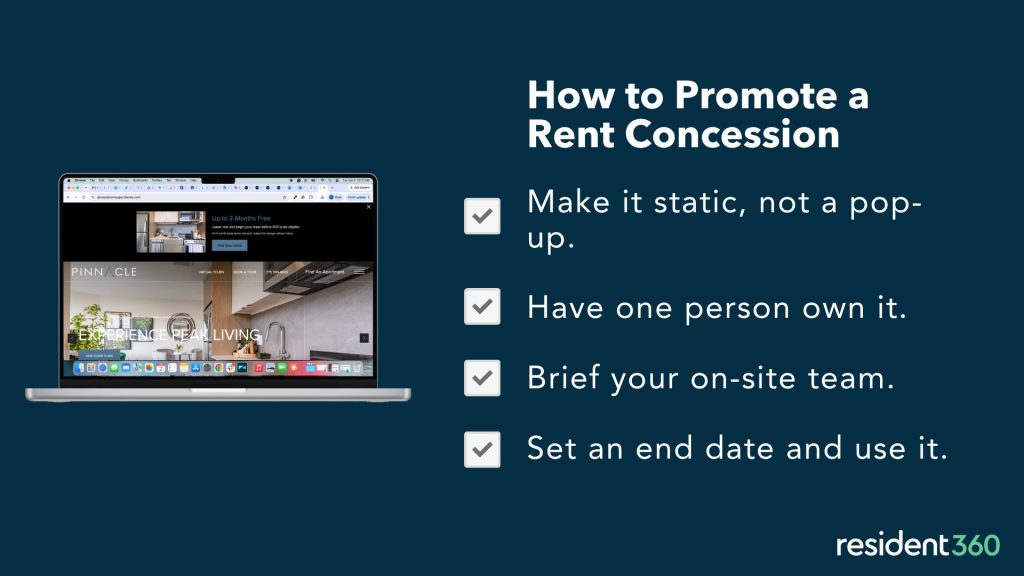
- Make it static, not a pop-up. Pop-ups get closed reflexively. Someone touring 10 websites in a day is going to click every X button without reading them. A static banner — on the homepage and on the floor plans page — keeps the offer visible when it matters most. When someone’s deep in the floor plan page doing math on whether they can afford that two-bedroom, you want the concession right there in their eyeline, not buried back on a homepage they’ve already scrolled past.
- Have one person own it. If multiple people are responsible for keeping the concession updated across platforms, nobody is actually responsible for it. Assign a single “specials gatekeeper.” This is someone who updates every channel simultaneously when a deal changes or expires, not one platform today and the PPC account next Tuesday.
- Brief your on-site team. This sounds obvious, but it breaks down constantly. Multifamily marketing and regional managers will align on a creative concession, and the leasing team giving tours has no idea it exists. If the person doing the tour can’t speak to the offer with genuine excitement, the concession loses half its power. The best specials are ones your on-site team is actually excited about, because that energy transfers.
- Set an end date and use it. Urgency is part of the value. “Sign by June 30th” gives a prospect a reason to act. Open-ended specials feel like a clearance rack; it signals you’re struggling to lease rather than running a smart, time-limited promotion. Even if you know the special will likely extend, put a date on it and re-evaluate.
For more apartment marketing ideas like this, read our blog for The Ultimate Guide to Apartment Marketing Ideas.
The Metrics That Actually Tell You If It’s Working
Running a creative apartment concession without tracking its impact is just spending money. The questions worth asking when you evaluate a special:
- Did traffic volume increase after it launched, or stay flat?
- Did tour-to-application conversion improve?
- Are you getting qualified applications, or just more traffic from people who aren’t actually a fit?
- Are prospects mentioning the offer when they tour? Is the leasing team hearing it come up organically?
- What’s the cost per lease compared to what you were spending before?
If you switched from “2 months free” to “2 months free + surf lessons” and saw no change in any of these metrics, the surf lessons might not be resonating with your specific renter profile. That’s useful information. If you saw a spike in tour volume and people are walking in saying they saw the surf lessons offer on Google — that’s the signal you’re looking for.
Differentiate or Discount — There’s No Middle Ground
The rental market right now is giving properties no choice but to compete. Supply is elevated in most Sun Belt markets. Renter demand has softened. Apartment concessions are everywhere. Defaulting to one month free is choosing to blend in at the exact moment you need to stand out.
The properties cutting through the noise are the ones thinking about their apartment concessions the way a marketer would: not just as a financial lever, but as a brand statement. Offering surf lessons tells an immediate story about your community culture. A Disney fireworks experience highlights a premium location. Even a practical perk like covering moving costs signals exactly how you treat your residents.
A month off rent says nothing. It’s a number. The best apartment concessions tell a story — and in a market where every competitor is running the same offer, a story is exactly what gets remembered.

Written by Josh Grillo
Josh Grillo is a #1 Best Selling Author, Speaker and Co-Founder of Resident360.
