How Multifamily Is Actually Using AI for Property Management in 2026
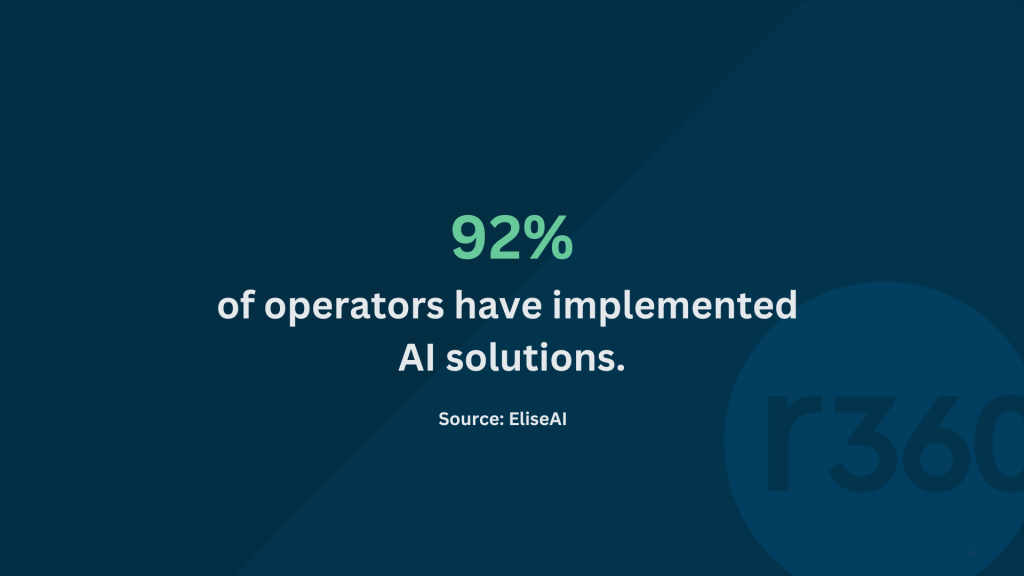
Overview: Adoption of AI for property management jumped from 21% in 2024 to 34% in 2025 — and the operators using it are reporting real reductions in operating costs and measurable improvements in lead-to-lease conversion. But the questions that actually matter aren’t about which tools to buy. They’re about where AI fits, where human judgment still wins, and how to start without wasting time on the wrong things.
Quick Links:
- Multifamily AI Adoption
- Our Survey Results
- The Adoption Curve
- What Multifamily Companies Are Actually Doing With AI
- Data Security
- Accountability & Compliance
- Does AI Help or Hurt Leasing?
- The 6th Sense Problem
- Will AI Actually Put Money on Your Bottom Line?
- The Content Question
- Where to Start (Without Losing a Month to Research)
- A Final Note
An Inside Look at Multifamily AI Management and Real-World Adoption
We recently sent a survey to our subscribers asking a simple question: What’s your biggest question about multifamily AI strategy right now?
We received responses from property owners, marketing directors, regional managers, and property managers operating portfolios ranging from a handful of units to 50+. The responses were refreshingly candid.
- “AI does not compare to humans. It is not analytical and does not have a 6th sense.”
- “I need time to test and play around.”
- “Does AI actually help or hurt leasing?”
- “Will it put more money on our bottom line or just become another necessary expense?”
- “What can be automated vs. what needs a human touch?”
- “How do I trust AI to get it right?”
- “How can we create consistent, scalable content that is optimized for AI search while still feeling human and authentic?”
No one asked about ChatGPT prompts or which tools have the best dashboards. They asked the real questions — the ones that sit underneath all the noise. Is this actually good for my business? Where does human judgment still matter? And how do I even start?
So we went looking for answers. Not in vendor case studies or conference keynotes, but in what AI property management platforms are actually delivering — and what the data says about whether it’s working.
Here’s what we found.
What Our Survey Actually Revealed
Before diving into what other companies are doing, it’s worth pausing on what the survey itself tells us about where the multifamily industry actually stands, because the honest picture is more useful than the hype.
The majority of our respondents said they’ve experimented with AI but have nothing formal yet. A meaningful portion uses a few tools consistently. Only two respondents said they have a defined AI for property management strategy. A handful haven’t started at all.
When asked what’s getting in the way, the most common answer was concerns about quality or accuracy. Close behind: we don’t have time to figure it out. A smaller group said leadership hasn’t prioritized it, or they don’t know where to start.
The platform picture was stark: ChatGPT dominates, used by a large majority of respondents. Claude and Gemini had a few users each. Several weren’t familiar with any platform at all.
As for where people most want AI’s help: marketing content and copywriting came out on top, followed closely by reporting and analytics, leasing and prospect communication, and resident communications.
What this tells us: the multifamily industry is in the early-majority phase of AI adoption — past “is this real?” and firmly into “how do we do this without making mistakes?” Those are the better questions. And they deserve direct answers.
The Adoption Curve Is Steeper Than You Think
If it feels like the conversation around AI for property management accelerated overnight, that’s because it kind of did.
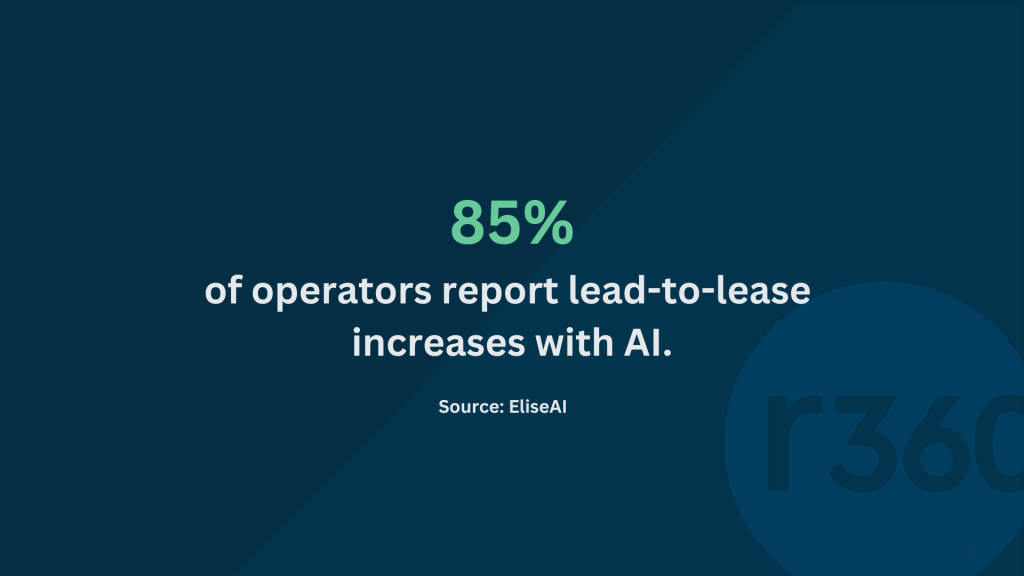
According to research from EliseAI, AI adoption in multifamily operations jumped from 21% in 2024 to 34% in 2025. Among operators already using multifamily AI management tools, 77% report moderate to significant reductions in operating expenses, and 85% have seen measurable improvements in lead-to-lease conversion rates.
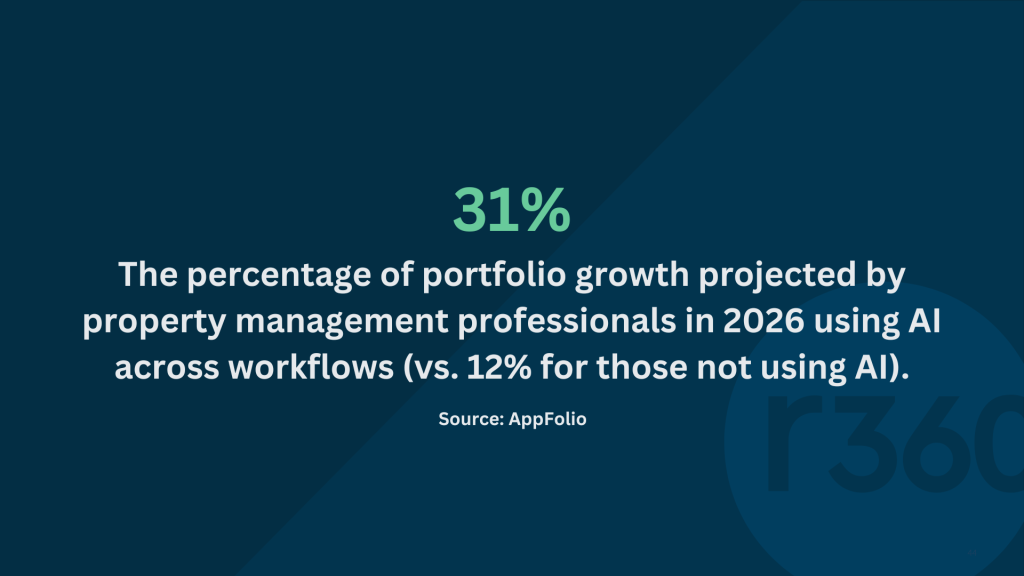
AppFolio’s data tells a similar story: property management professionals using AI broadly across core workflows are projecting 31% portfolio growth in 2026, compared to 12% for those not using AI.
Those numbers don’t mean everyone should sprint toward adoption. But they do mean the companies not paying attention are falling further behind the ones that are. A thoughtful multifamily AI strategy (even a limited one) is starting to separate operators in measurable ways.
What Multifamily Companies Are Actually Doing With AI
The practical applications of AI property management fall into a few clear buckets. Here’s how they’re playing out in the real world.
AI for Leasing
The most widespread use case in multifamily AI management right now is leasing automation — specifically, platforms that handle prospect communication across text, email, chat, and phone before a human leasing agent ever enters the picture.
- EliseAI is frequently utilized to automate the early stages of the leasing funnel, from inquiry responses to tour scheduling. According to a joint study, communities utilizing the automated system maintained an average 2% occupancy advantage over 12 months compared to non-users in the same submarkets.
- The Breeden Company, a Virginia-based multifamily operator, deployed an AI leasing tool that scheduled more than 13,000 tours over 12 months and secured 7,800 approved applications — a 60% closing ratio, compared to their previous rate of 40–50%. That’s not a marginal improvement. That’s a structural shift in how their leasing funnel performs.
- BH Communities saw a 42% increase in application submissions after adopting AI leasing tools.
- Funnel Leasing, another platform in the space, counts Camden Property Trust and Essex Property Trust among its clients and reports up to 35% efficiency improvements across large portfolios.
The thread connecting all of these: AI doesn’t close the lease. It handles the hours of follow-up, scheduling, and qualification that happen before a human can do their best work.
AI for Operations and Analytics
Some of the most practical AI applications aren’t in big leasing platforms — they’re in the daily workflows and back-office functions that quietly eat up team time.
At BH Management, leadership recognized around 2023-2024 that teams were getting leaner while clients were demanding more: more reporting, more data, more insights, faster. Their response was to build an AI-powered weekly report that generates actionable insights for each property in their national portfolio.
WinnCompanies has deployed a company-licensed AI tool that pulls from internal templates and policy documents to draft resident letters in seconds — and asks the team member whether the output should be an email, a printed document, or a resident portal post before generating. Staff can edit in real time or regenerate if it’s not right. WinnCompanies also uses AI to prepare onsite teams for difficult conversations (the kind that used to require hours of careful thought).
Crystal O’Brien, Vice President of Human Resources at WinnCompanies, described the time savings when prepping for sensitive resident or staff discussions: “If I would have had AI, it would have gotten so much faster.”
The same efficiency is showing up in back-office and data functions. VTS built Proposal AI as an agent that automates commercial proposal entry by 93%, saving users more than 25,000 hours of manual work annually.
Prophia, an AI-powered lease abstraction platform, combines AI with human oversight to deliver 99% accuracy on lease data extraction — the kind of foundational work that usually falls to junior staff or external services.
Then there’s what’s happening at the platform level. In June 2026, AppFolio unveiled a connector between its Realm-X AI suite and Claude (Anthropic’s AI platform). Property managers can trigger complex operational work (portfolio reporting, occupancy analysis, document review) with every action governed by AppFolio’s native compliance rules and accounting logic. It’s not a chatbot layered on top of the software. It’s AI executing real operational jobs inside the platform. Yardi announced a similar integration: the first property management connector for Claude, covering the full multifamily workflow from customer acquisition through resident retention.
Taken together, these aren’t isolated tools. They signal where the industry is heading: AI moving from a writing assistant you open in a separate tab to an operational agent embedded in the systems your team already uses every day.
AI for Maintenance
Leasing gets most of the press, but maintenance is arguably where AI for property management has the bigger quality-of-life impact, for both residents and teams.
- Property Meld acquired Mezo in early 2025, adding Mezo’s virtual maintenance technician (MAX™) to its platform. MAX™ guides residents through diagnosing maintenance issues before a work order is ever created, and the results show 30% faster work order resolutions.
- MRI Software’s chatbot system automatically processes over 60% of routine maintenance requests, routing and triaging without requiring staff involvement. Livly’s AI assistant reduced after-hours maintenance calls by 35% for a 500-unit portfolio.
- SmartRent has deployed smart home solutions across more than 828,000 units. Their SMRT IQ platform uses AI to surface insights from property-level device data. Communities using their solutions have reported reduced energy and water utility costs by nearly 20%.
A Word on Data Security (Don’t Skip This)
One of the most important things said at Apartmentalize 2026 didn’t get enough industry coverage: what happens when employees use free, public AI tools with sensitive property data.
Anne Hollander, Vice President of AI and Innovation at WinnCompanies, described an incident where an employee at another company input a property’s financial information — rent rolls, operating statements, trial balances — into the free version of ChatGPT. Later, a lender searching for information on that asset found the private data surfaced in ChatGPT results. The data was accurate. And it didn’t match what the property management firm had been reporting to them.
“What do you think happened with that property manager,” Hollander said. “That was probably not a fun phone call.”
If your team is using AI for property management tools (and they should be) the version matters. Company-licensed tools with privacy protections keep your data yours. Free, public versions do not. This is a policy question worth settling before it becomes a problem.
The Accountability Question
The data security story above is a symptom of a bigger issue the industry is only beginning to grapple with: when AI gets something wrong, who is responsible?
The answer, in nearly every case, is the operator, not the vendor. When AI communicates pricing, availability, or lease terms to a prospect at scale, fair housing requirements, state pricing regulations, and disclosure obligations still apply. The fact that a software platform generated the message doesn’t transfer the liability. That stays with whoever’s name is on the property.
This isn’t hypothetical. A Grant Thornton survey published in June 2026 found that only 13% of construction and real estate leaders say they could pass an AI governance audit in the next 90 days. Vendors are embedding AI into platforms faster than most operators can govern it. The Real Estate Technology and Transformation Center (RETTC) released a formal AI Governance Framework for rental housing this year; a sign the industry recognizes this gap and is starting to address it.
The practical implication: before expanding AI use, decide who owns what. Which AI outputs require human review before reaching a resident? What happens when AI gets a policy detail wrong? Those aren’t edge-case concerns — they’re operational decisions that should be made before you go live, not after something surfaces in an audit or a fair housing complaint.
Does AI Help or Hurt Leasing? (An Honest Answer)
This was another question our survey respondents asked, and it deserves a direct answer: the data says it helps — but only when it’s used for the right tasks.
AI leasing platforms excel at volume, speed, and consistency. They respond to every inquiry immediately (at 2 a.m. on a Sunday), they don’t forget to follow up, and they don’t have a bad week. For properties managing 200+ units with a two-person leasing team, that availability is meaningful.
But AI still stumbles on nuance. A prospect who asks a pointed question about the neighborhood, or a resident whose renewal conversation needs actual relationship management — these are moments where human judgment changes outcomes.
Research from Blueprint’s 2026 analysis specifically identifies the handoff moment as AI’s biggest current weakness in multifamily AI management: the transition from automated conversation to human engagement isn’t always clean, and when it’s clumsy, it costs conversions.
So does AI help or hurt leasing? My personal take (and the most honest answer) is that it can easily do both. Every multifamily portfolio is structured differently, meaning the technology is neither an automatic savior nor an inherent risk. The impact of multifamily AI management depends entirely on how it is deployed and monitored.
The operators getting the best results aren’t asking whether to use AI or people. They’re designing workflows where AI handles volume and humans handle relationships, and they’re being thoughtful about where the handoff happens. What I mean by this is that they’re using automation to handle repetitive top-of-funnel tasks so their leasing team has time to build actual human relationships. If you treat AI as a complete replacement for human oversight, it will likely hurt leasing. Left entirely to its own devices, automation can alienate renters when conversations require genuine empathy or local context.
A practical way to think about the division: AI handles initial prospect response and follow-up, tour scheduling, routine maintenance triage, resident letter drafts, weekly reporting, and document summarization well. Humans still need to own the tour experience, renewal conversations with long-term residents, escalated resident issues, and any situation where empathy or local context determines the outcome.
The 6th Sense Problem
One of our survey responders put it plainly: “AI is not analytical and does not have a 6th sense.”
They’re not wrong — and it’s worth sitting with that observation rather than dismissing it as AI skepticism.
Experienced leasing professionals carry intuition built from thousands of interactions: when a prospect is serious vs. browsing, when a resident’s complaint signals something bigger, when pricing feels off before the spreadsheet confirms it. That pattern recognition is real, and it’s not something a language model replicates from a chatbot conversation.
What AI does instead is handle the work that surrounds those judgment calls. It triages, responds, schedules, and documents — so that when a leasing agent’s 6th sense kicks in, they’re spending their time on the conversations that actually require it, not buried in follow-up emails.
The companies using AI for property management most effectively treat it as an amplifier of human judgment, not a replacement for it.
AI leasing assistants are popping up everywhere. Are they actually helping properties close more leases, or is this just the latest industry buzzword? Find out in the Multifamily Marketers Podcast, episode 15.
Will AI Actually Put Money on Your Bottom Line?
One of our survey respondents asked it directly: “Will it put more money on our bottom line or just become another necessary expense?”
Honest answer: it depends entirely on how you deploy it.
The operators seeing real financial returns are using AI to drive two things simultaneously — cost reduction and revenue improvement. EliseAI’s data shows operators on their platform average a 2% higher occupancy rate over 12 months compared to those not using it. At scale, that’s significant. The Breeden Company’s 60% closing ratio versus their previous 40–50% represents real lease revenue that wouldn’t have existed otherwise.
On the cost side, when AI tools save onsite staff hours of routine work each week, teams reinvest that time into higher-value leasing and relationship activity. This makes the math straightforward.
Where AI becomes just another expense:
- When it’s adopted without a clear workflow integration
- When staff are not trained to use it effectively
- When it’s layered on top of broken processes rather than designed to improve them
A tool isn’t a strategy. The operators building a real multifamily AI strategy (one tied to specific operational outcomes like occupancy rate, cost per lead, and time-to-lease) are the ones seeing it move the line.
The Content Question
One of the more forward-looking questions from our survey: “How can we create consistent, scalable content across all marketing channels that is optimized for AI search and discovery while still feeling authentic, human, and engaging?”
This is the question that keeps marketers up at night right now, and it’s the right one to be asking.
The short version: AI-optimized content and human-feeling content are not opposites. Search engines, including AI-powered ones, increasingly surface content that answers specific questions directly and demonstrates genuine expertise. Generic, templated content performs worse, not better, in this environment.
There’s a term emerging in marketing circles worth knowing: Generative Engine Optimization (GEO). Traditional SEO was about ranking in Google’s blue links. GEO requires your brand to secure citations inside AI-generated answers because renters increasingly get their information there. If AI tools exclude your property from the content they draw from, you effectively disappear.
What that means practically is that multifamily marketing content needs to be:
- Specific (amenity descriptions that reflect the actual property, not a template)
- Conversational (written for how people talk, not how brochures read)
- Structured around the questions prospects are actually asking
That last piece is more important than ever because AI search tools are literally extracting answers to questions. Content that’s built around real questions gets surfaced. Content built around brand voice alone does not.
For operators thinking about multifamily AI marketing services, this is where expertise matters most. Not in automating content production, but in making sure what gets produced is worth amplifying in the first place. Consistency and authenticity aren’t at odds with AI optimization. They’re required by it.
Where to Start (Without Losing a Month to Research)
If you’re not sure where to begin with AI for property management, the answer almost everyone in the industry gives is the same. Start with the highest-volume, most repetitive communication in your operation and ask whether AI can handle it better.
For most multifamily operators, that’s initial prospect follow-up — not closing, just response, qualification, and scheduling. Piloting an AI leasing tool on one property before rolling out portfolio-wide is how most of the companies above got started. It’s the lowest-risk way to build a proof of concept.
A few other practical entry points based on what we’re seeing:
- Use a company-licensed AI tool (not a free public version) to draft resident letters and communications
- Ask your property management software vendor whether they have an AI integration — AppFolio and Yardi both do now
- Use AI to generate a first draft of your weekly performance summary, then have a human refine and add context
The operators falling behind aren’t the ones who haven’t found the perfect AI stack. They’re the ones who haven’t started testing anything at all. You don’t need a full multifamily AI strategy on day one. You need one workflow that works — and proof of concept to build from.
A Final Note
Our survey respondents didn’t ask naive questions. They raised exactly the right points, driven by real operational concerns, healthy skepticism, and a genuine desire to understand what actually works.
That instinct is good. AI in property management is not a single product or a clear-cut decision. It’s a category of tools that, used well, changes what your team can do. And used poorly, adds complexity without adding value.
The companies seeing results aren’t the early adopters who moved fastest. They’re the ones who moved thoughtfully: testing it out, measuring outcomes, and building AI into workflows designed around human strengths.
That’s the model worth following.

Written by Josh Grillo
Josh Grillo is a #1 Best Selling Author, Speaker and Co-Founder of Resident360.
