Overview: To choose a multifamily digital marketing agency in 2026, property management companies should test three things: whether the agency can tie its work to signed leases, whether the company owns every account and asset the agency uses, and whether the agency can make its communities visible in AI tools like ChatGPT and Google AI Overviews. This guide covers the questions to ask, red flags to watch for, contract terms to verify, and a free scorecard to compare finalists.
What Your Agency’s Pitch Deck Won’t Tell You
Here’s an uncomfortable test for your current marketing agency. If you ended the relationship tomorrow, would you walk away with your ad accounts, analytics, website, and call-tracking numbers?
Could your agency show you, property by property, which of last quarter’s signed leases its work produced?
And if a renter asked ChatGPT for the best apartments in your submarket, would your community come up?
Most management companies can’t say yes to all three. Those questions are the real tests for choosing a multifamily digital marketing agency in 2026: can the agency prove leases, do you own what it touches, and can renters find you in AI search?
This guide shows you how to check each one before you sign, through sharper pitch-meeting questions, research the agency can’t control, and contract terms that protect you on the way out.
The Pitch Deck Was Built for a Search Era That’s Ending
Most agency searches for apartment portfolios still run on an old script. Three agencies present. Each one shows a reel of handsome websites and a slide of cost-per-click benchmarks, someone from asset management asks about reporting, and the contract goes to whoever sounded most confident in the room.
That script assumed a renter typed a query into Google, clicked a result, and filled out a form you could count. In 2026, a growing share of that path happens where no dashboard can see it.
The numbers make the shift hard to dismiss. In a February 2026 survey, Pew Research Center found that 44% of U.S. adults say they use ChatGPT or another AI chatbot, including 61% of adults ages 18 to 29 and 55% of those ages 30 to 49. Those two age bands make up the core of most renter pools.
A separate Pew analysis of real browsing behavior found that Google users clicked a traditional result on just 8% of visits when an AI summary appeared, compared with 15% when none did, and clicked a source cited inside the summary on only 1% of visits.
A renter can now compare your community against three competitors, read a synthesized take on your reviews, and decide not to tour without ever reaching your website.
That changes what you should buy. The agency you hire has to do well at things that never appeared in an RFP three years ago, and a polished deck tells you almost nothing about whether it can.
Bookmark the four tools near the end: pitch questions, red flags, pre-signing checks, and a weighted scorecard. They work whether you’re replacing an incumbent, consolidating vendors across a portfolio, or hiring your first outside partner.
Do your own homework before you send an RFP
The weakest agency evaluations start with the agency. The strongest start with three internal answers that most management companies have never written down.
The first is your definition of a lead. If a property counts a chatbot conversation, a phone call longer than 30 seconds, and a completed guest card as equal leads, every agency will look great, and none of the numbers will mean anything. Agree on what counts before anyone pitches. Then give that definition to every finalist so you can compare answers on the same terms.
Don’t ask, “How many leads did we get?” Ask, “How many qualified leads did we get?” That means tracking tour rate, application rate, lease conversions, cost per lease, and the quality of each lead source, not just the total.
The second answer is your cost per lease, by property, for the last 12 months. You probably can’t calculate it perfectly, and that’s fine. Build a rough figure from your property management software, your ILS invoices, and your current ad spend. It gives you a baseline to hold agencies to, and it shows which properties carry the portfolio and which drain it. An agency that asks for this number in the first meeting understands the business. An agency that never asks is selling you activity.
The third answer is an inventory of who controls your digital assets today:
- Google Ads and Meta Business Manager
- Google Analytics 4 and Google Business Profiles
- domains and website hosting
- call-tracking numbers
- creative files
Many management companies discover during this exercise that their current agency owns half of it. Finding that out before a transition is a planning task. Finding it out after you give notice turns into a negotiation you will lose.
Knowing what you own and what counts as a lead is the starting point. Keeping an eye on both is the ongoing work. Josh and Caroline share the eight things worth checking every Monday in Ep 50 of The Multifamily Marketers Podcast, “The 10-Minute Marketing Audit Every Property Should Do Every Monday.”
What to search for before the first meeting
A multifamily marketing agency controls everything in its pitch. It controls almost nothing about what the open web says about it, which makes independent research the most honest part of the process. Spend an hour on each finalist before you take a call.
Start by asking AI tools about the agency. Type the agency’s name into ChatGPT, Perplexity, and Google, and ask each one what the firm does, which property types it serves, and what clients say about it. Then ask a category question, such as “Which agencies specialize in marketing for student housing communities?” An agency that sells AI visibility should show up in the answers. If it can’t make itself visible to these tools, that tells you something about what it will do for your properties.
Next, look at the agency’s live client work instead of the case studies it chose to show you. Pick three communities the agency lists as clients, and for each one:
- Check whether the property’s name, phone number, hours, and branding match across its website, its Google Business Profile, and its main ILS listings.
- Run the homepage through Google’s free PageSpeed Insights tool on mobile.
- Read the property’s recent review responses and notice whether they sound like a person or a template.
- Call the phone number on the property’s website and note who answers. If you’re calling Main Street Apartments and Forest at the Glen answers the phone, there’s a problem.
- Check whether the homepage special has already expired. On the sites our team reviews, outdated specials are often 30 to 60 days past their end date.
- Click the social media icons. Website templates get copied from property to property, and the links often come along.
This tells you how the agency performs on a normal Tuesday, which matters more than how it performs on its showcase account.
Finally, verify the credentials the agency claims. If it calls itself a Google Partner or Premier Partner, confirm the status in Google’s public Partners directory. The distinction means something. Google awards Premier Partner status only to companies that already meet its Partner requirements and rank in the top 3% of participating companies in their country, reassessed every year. Resident360 holds that status, and we’d still tell you to check the directory rather than trust anyone’s badge.
Several of the checks above come straight from the audit our team runs on client websites. To run the full version on your own properties, tune in to Ep 24, where Josh and Caroline walk through “The 30-Minute Website Audit Every Multifamily Team Should Run.”
Ask every finalist to audit one of your properties
Research tells you how an agency treats its current clients. An audit shows you how it would treat yours, before you’ve spent a dollar. Pick one property, ideally one that’s struggling, and ask each finalist to evaluate it before the final meeting. Plenty of agencies will agree to it. The difference shows up in what comes back.
A useful audit follows the whole path a renter takes, not just the website. It should cover:
- the property website and Google Business Profile
- organic and paid social
- Google Ads and local search demand
- geofencing and SEO
- how the property appears in AI answers
- what competitors are advertising in your market right now
Start with the basics. A property website boils down to three jobs: a prospect has to be able to call you, schedule a tour or reach you through a form, and see accurate pricing and availability. That’s the whole game.
A good audit tests all three the way a renter would. That means calling the number while watching the CRM to see whether the call registers and gets credited to the right source, submitting every form, and checking the listed prices against what’s actually available.
Each finding should name something specific, such as a page, a review count, a phone number that doesn’t match the listing, or a special buried in a pop-up. Then it should explain the fix and connect it to leasing. A good audit also credits what’s already working. One that finds nothing good about your property is usually a template.
The most important page is the budget. A strong partner works backward from your goal. It starts with how many units you need to lease or keep leased, then how many leads that takes, then what search demand and click costs in your submarket say those leads will cost. That math turns a recommendation into a number your asset manager can test. An agency that recommends a budget without showing how it got there is guessing.
This is a big part of how we work at Resident360. When a management company comes to us for help, our team builds a free digital marketing audit of their property by hand, covering every channel listed above. We also do the math to estimate how much paid media it will take to generate enough leads to reach and hold high occupancy. We think that’s the standard every agency should be held to, including us.
Why AI visibility belongs on the shortlist, not in a footnote
Most agencies now mention AI search in their pitch. Far fewer can explain what they would change on your properties to influence it. The work is concrete. AI tools assemble answers from sources they can parse and trust:
- structured data on your website
- consistent business information across directories
- review content and local press
- pages that answer the specific questions renters ask, such as pet policies, parking costs, commute times, and what the neighborhood is like after dark
A community with a beautiful homepage and thin, inconsistent information everywhere else tends to disappear from these answers.
This also changes how you should read an agency’s reporting. If fewer renters click, website traffic stops working as the headline metric. A good partner in 2026 tracks three things:
- whether your properties appear in AI answers for the queries that matter in each submarket
- whether those answers describe your communities accurately
- whether leads and tours hold steady even as sessions fall
Ask every finalist to show you that kind of report for a current client. If they can only show you traffic charts, they’re measuring the old funnel.
The most revealing request you can make takes 10 minutes. In the pitch meeting, give each agency the name of one of your properties. Ask them to run a live query in ChatGPT and Google, such as “best apartments near [your submarket] for [your target renter].” Then ask them to explain what came back, what’s wrong with it, and what they would fix first. You’ll learn more from that conversation than from any capabilities slide.
Compliance is now a selection criterion
Fair Housing risk in digital advertising used to sit mostly with the platforms. Meta’s 2022 settlement with the Department of Justice required three changes for housing ads. Meta had to stop using its lookalike-style Special Ad Audience tool, remove targeting options tied to characteristics the Fair Housing Act protects, and run a Variance Reduction System designed to bring each ad’s actual audience closer to its eligible audience.
Court oversight of that settlement was scheduled to run through June 27, 2026. Whatever happens to platform-level oversight from here, the responsibility still lands on your company and the partner you hire. That covers what your ads say, which images they use, and who they reach.
The same logic applies to AI-generated content and to accessibility. An agency that writes listing descriptions, ad copy, or neighborhood pages with AI tools needs a human review step that checks for Fair Housing language problems. It should be able to describe that step in detail.
Your websites should meet current accessibility standards, and your agency should tell you which standard it builds to and how it tests. “We follow best practices” doesn’t count as an answer to either question.
Listen to the questions the agency asks you
Most evaluation processes focus on how an agency answers. The questions it asks back often reveal more. A strong multifamily marketing agency partner will want to know:
- your occupancy and leased percentages by property
- which communities face new supply nearby
- how fast your leasing teams follow up on leads
- what your owners or asset managers expect to see each month
It will also ask about concessions, because a concession strategy and an ad strategy that contradict each other waste money at both ends.
Pay attention to whether the agency asks about operations at all. Marketing can fill a calendar with tours. But a property that takes two days to return a call, or loses prospects at the application stage, will convert those tours poorly, and the agency’s numbers will suffer for it.
The best partners check this directly by listening to call recordings, not just counting calls. Sometimes marketing can get blamed when really the issue is happening after the phone rings.
A partner that asks about speed to lead, tour-to-lease conversion, and renewal rates understands that its results depend on your site teams. One that only asks about budget and brand guidelines plans to run campaigns, report on them, and leave the rest to you.
Keep a simple tally during each meeting: questions the agency asked about your business versus minutes it spent talking about itself. The ratio tells you how the relationship will feel six months in.
One agency or several?
Every management company eventually faces this choice, and we should name our bias up front. Resident360 handles brand, websites, paid media, SEO, and AI visibility under one roof, so we have a stake in the answer. Here is the fair version of the argument anyway.
Specialists can go deeper in a single channel. A well-coordinated in-house team can get excellent results from a paid-media firm, a web developer, and a separate creative studio.
The cost of that setup shows up in the gaps between vendors. When leads drop at a property, the paid-media firm points to the website, the web developer points to the ad targeting, and nobody owns the answer. Brand consistency breaks down because three vendors read the same guidelines three different ways. AI visibility makes the gaps worse, because it depends on the website, the listings, the reviews, and the ads all telling the same story.
If you split the work, assign one internal person who owns cross-channel results. That person should give every vendor the same lead definition and the same reporting calendar. If you consolidate, make sure the agency runs each channel with its own experienced specialists rather than one generalist covering everything.

The Field Guide: Four Tools to Bookmark
1. Questions to ask in pitch meetings
Send these to finalists in advance. Good agencies welcome the preparation, and you’ll get better answers than you would by asking cold.
On results and attribution
- How do you connect a click, call, or AI referral to a signed lease, and which systems do you integrate with to do it?
- Show us a report from a current multifamily client (if permissible). What would you have told that client last month if leases fell while traffic rose?
- Which metric would you want us to judge you on in the first 90 days, and which one after a year?
- Will you audit one of our properties before we sign, including a recommended budget and how you calculated it?
On AI search visibility
- What specifically would you change on our websites and listings to improve how AI tools describe our properties?
- How do you measure whether a property appears in AI answers, and how often do you report on it?
On compliance
- Who reviews ad copy, images, and AI-generated content for Fair Housing issues before it goes live, and what training do they have?
- Which accessibility standard do you build websites to, and how do you test it?
On the team
- Who will work on our account day to day, how long have they been with you, and how many other accounts do they manage?
- What happens to our account when that person leaves?
On money
- Do you mark up media spend, software, or third-party tools? If so, by how much?
- What does it cost us to leave, and what will you hand over on the way out?
2. Red flags to watch for
- The agency wants to run your ads inside its own ad accounts instead of accounts your company owns.
- Reports lead with impressions, clicks, and traffic, and the agency gets vague when you ask about tours and leases.
- The agency’s audit could describe any property: generic findings, no screenshots, and a budget with no math behind it.
- The pitch team includes senior people you will never see again after signing.
- The agency promises specific rankings, a guaranteed number of leads, or placement in AI answers. Nobody controls those outcomes, and an agency that claims to is either naive or selling.
- Pricing bundles media spend and fees together so you can’t see what the agency keeps.
- The agency can’t name a time it told a client to spend less.
- Its own website loads slowly on mobile, or its AI visibility pitch doesn’t hold up when you search for the agency itself.
- References all come from clients signed in the last six months.
3. What to verify before signing
Get each of these into the contract, or in writing from the agency, before you commit. Each one protects you during the transition you hope never happens.
- Your company owns every ad account, analytics property, Google Business Profile, domain, and social account, and the agency works in them through access you grant.
- The contract states who owns the website code, design files, photography, video, and written content, and when ownership transfers.
- Call-tracking numbers either belong to you or move to you at no cost when the relationship ends.
- The agency discloses all media markups, software fees, and third-party costs in writing.
- The termination clause sets a reasonable notice period and lists exactly what the agency hands over and by when.
- Reporting definitions, including what counts as a lead, appear in the scope of work.
- The agency names the people assigned to your account and commits to telling you about staffing changes.
- You’ve spoken with at least two references the agency has served for more than two years, including one that has since left.
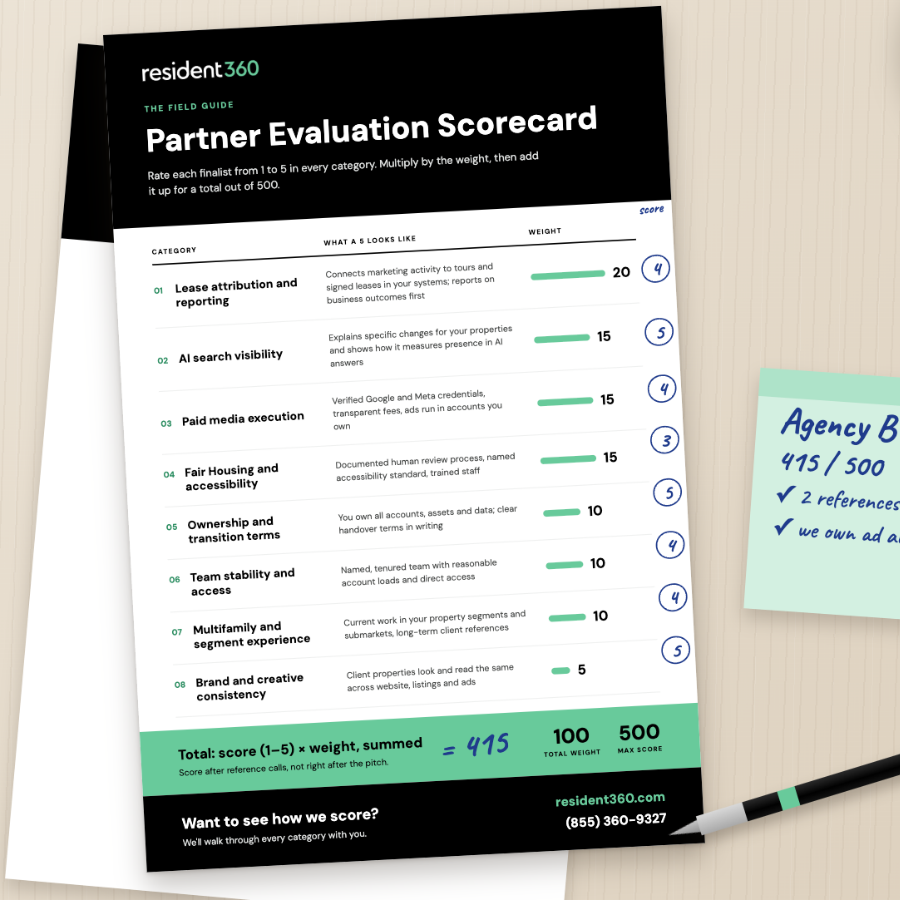
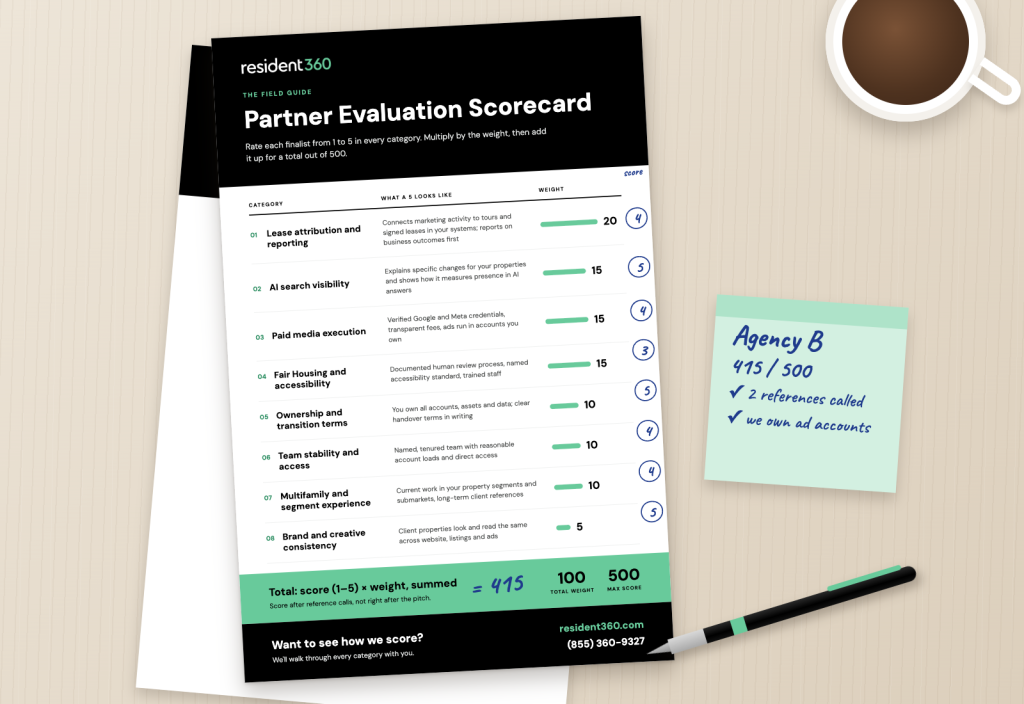
4. The partner evaluation scorecard
Score each finalist from 1 to 5 in every category, multiply by the weight, and add the results for a total out of 500. Fill it out after reference calls and your own research, not right after the pitch, when presentation skills tend to inflate every score. Adjust the weights to fit your portfolio. A company with several lease-ups underway might move more weight to paid media and creative.

Choose the Partner You Can Hold Accountable
Apartment operators have never had more agencies to choose from, and the differences in quality have never been harder to see from a conference room. Polished creative and confident presenters now come standard. What separates partners in 2026 comes down to three things.
- Will they tie their work to your leases and your NOI?
- Will they leave you in control of your own data?
- Do they understand that a renter may form an opinion of your community inside an AI answer before your website ever loads?
There’s one mistake we see more than any other: properties only look closely at their marketing once occupancy starts to drop. The properties that consistently perform well aren’t necessarily spending more money, but they are paying attention more often. The right partner pays that kind of attention every week, not just when the numbers turn.
None of the tools above require a large budget or a procurement department. They require you to decide what you’re measuring before anyone pitches, to check what the agency says against what the web says, and to put ownership in writing.
An agency worth hiring will respect that process. An agency that pushes back on it has told you something useful.
If you’d like to see how Resident360 answers every question on this list, we’re glad to walk through it with you.
Either way, ask yourself one question before your next agency meeting: if your current partner disappeared tomorrow, how much of your marketing would you still own?